Building a Governance Engine from Zero Requirements
Overview
Uptempo is a B2B SaaS platform for centralized enterprise financial marketing operations, planning, budgeting, execution, and measurement, used by global enterprises like Porsche, Estée Lauder, Amazon, and IKEA.
This case demonstrates how end-to-end product ownership turned an undefined business requirement into a validated enterprise governance engine. Driven by a structured Design Thinking approach and AI-assisted workflows, it highlights how lateral leadership across Product, Design, and executive stakeholders aligned cross-functional teams to prove the desirability, feasibility, and long-term sustainability of a new platform capability.
Case Metadata
Role
Senior Product & UX Designer (with cross-functional PO responsibilities)
Scope
Enterprise B2B SaaS platform — a centralized approval workflow system spanning the marketing operations modules
Validate the desirability, feasibility, and sustainability of a product defined only by three clients' raw demands — and make it work for the entire client base
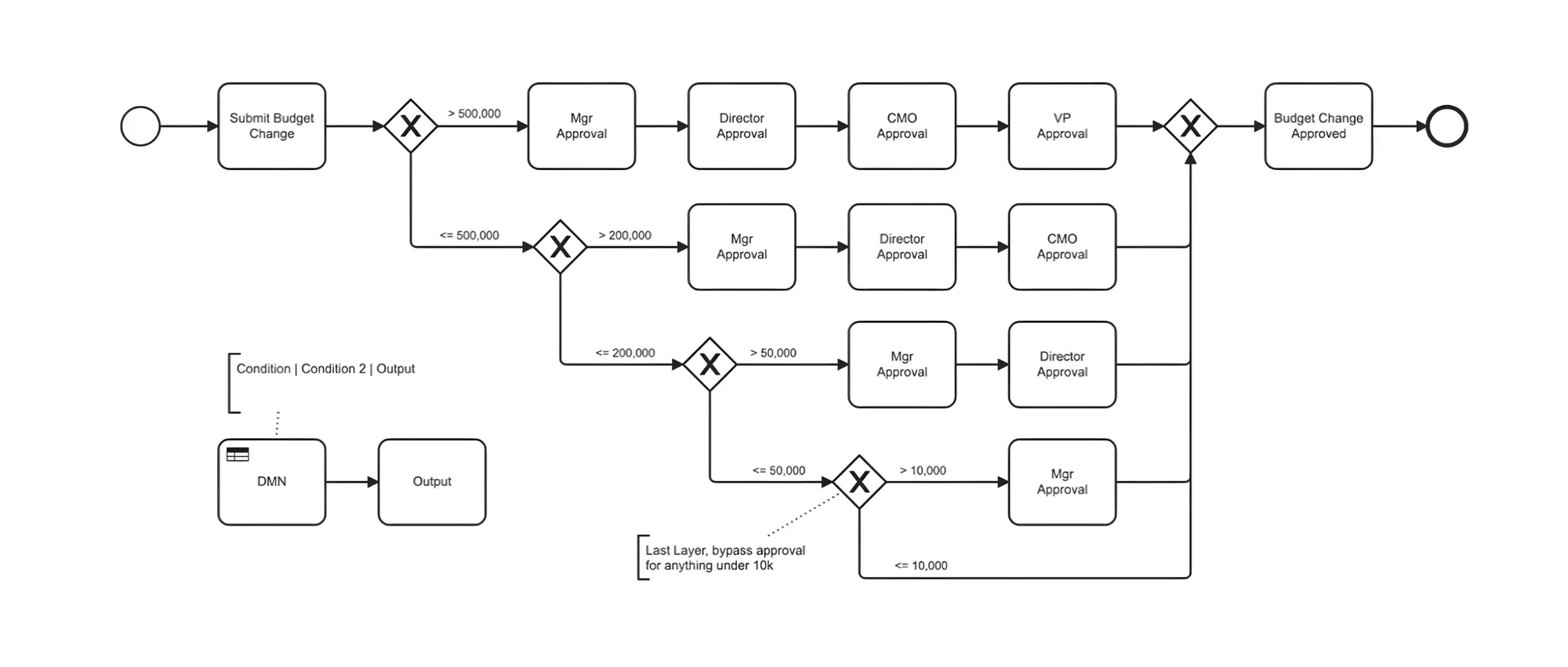
Tier-1 enterprise clients like IBM, Dell, and Porsche required centralized financial governance, which reached Uptempo as a single vague demand: "the platform needs approval workflows." With zero specifications, user stories, or defined scope, and one raw model provided by a single client.
Based on this model, we were asked to validate the desirability and feasibility of the product. In practice, this meant owning the full end-to-end process: framing the problem, running discovery, architecting the system, aligning the organization, and designing the solution through to MVP.
Starting point: a feature name, three demanding clients, and a hundred more clients who would inherit whatever we built.
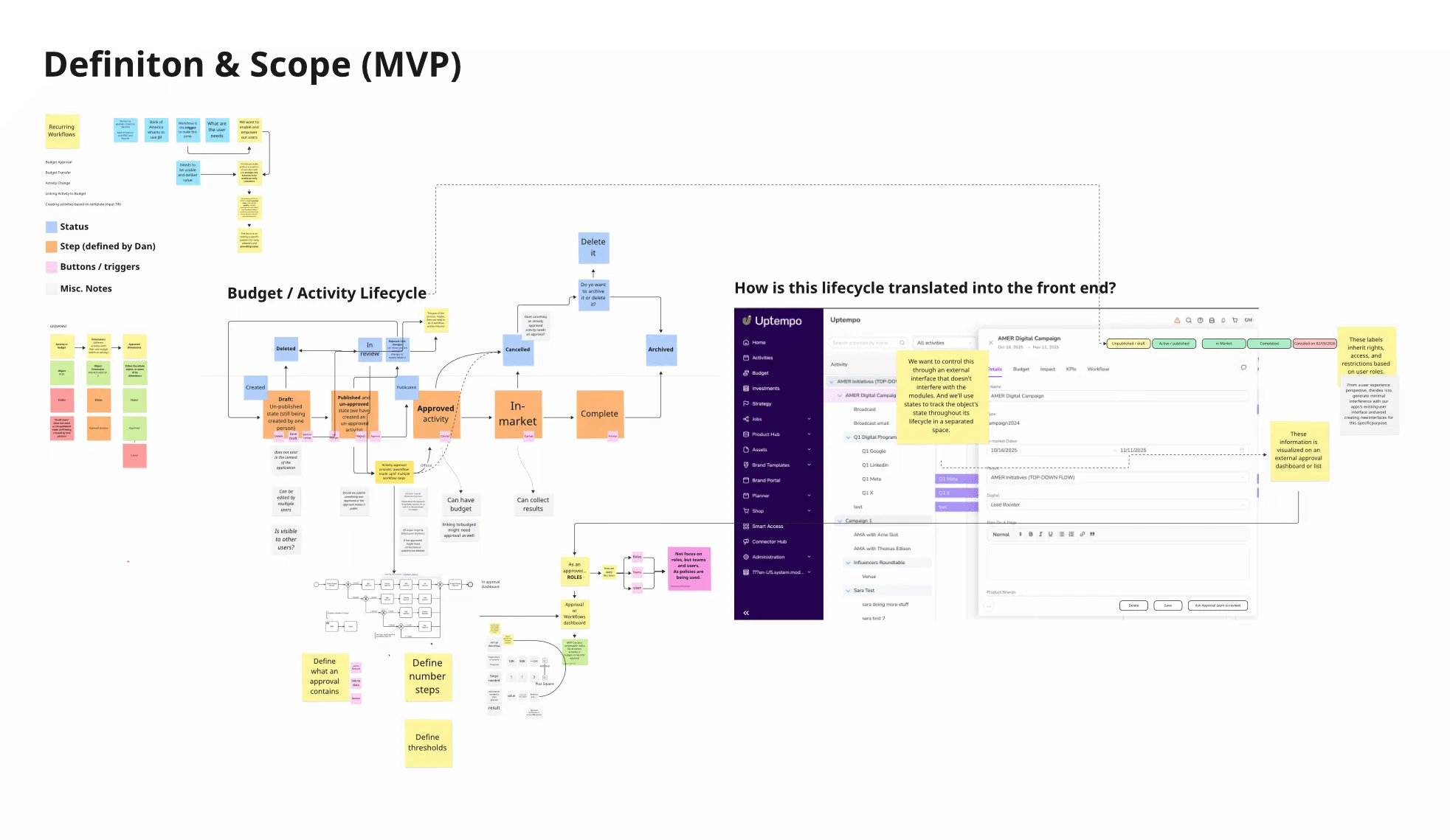
I started by facilitating a workshop to align Product Managers, define what an approval workflow meant for Uptempo, and assess its technical feasibility.
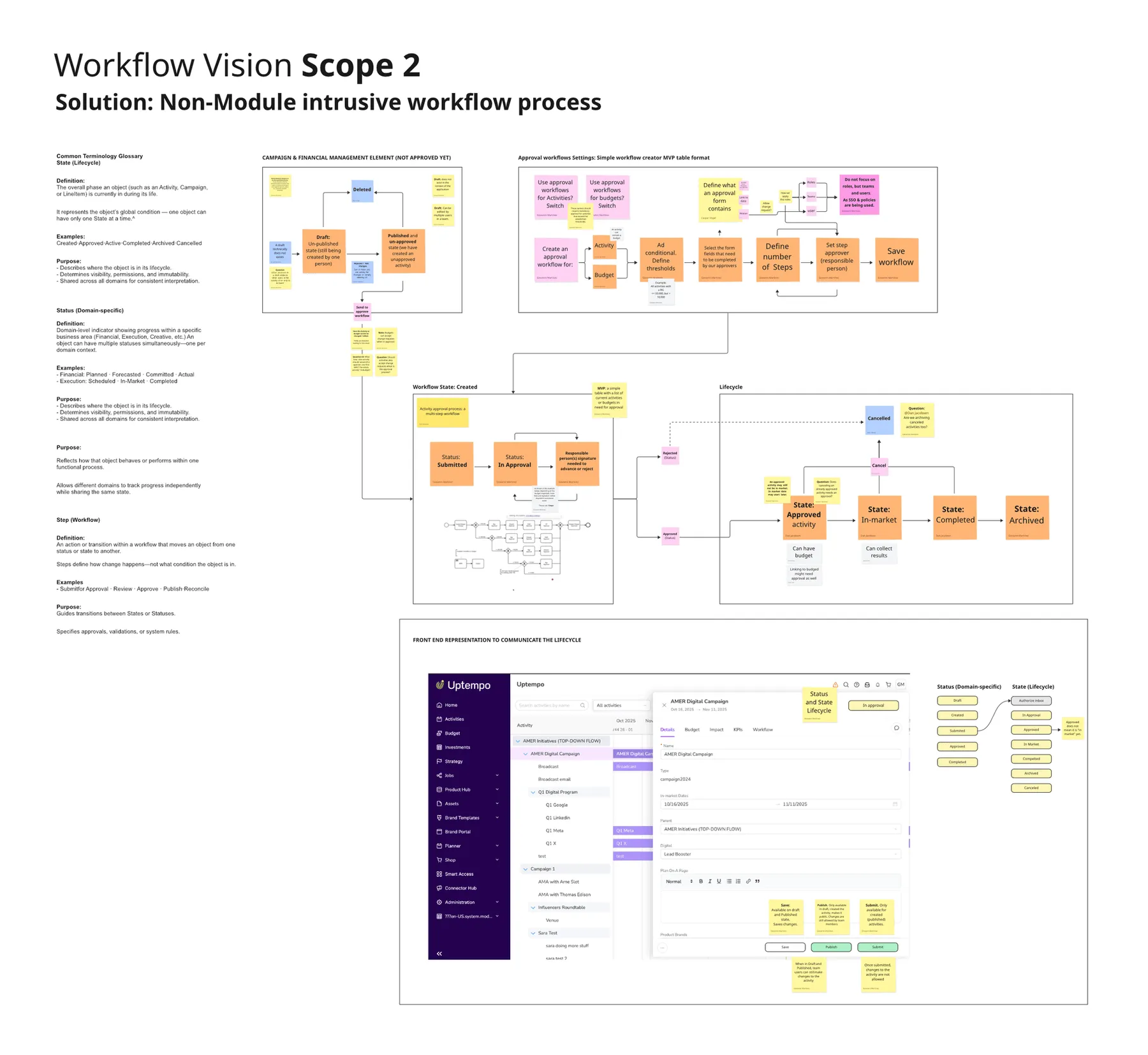
We mapped the workflow against a marketing activity's lifecycle forced a critical architecture decision: whether approvals should be embedded within individual modules or built as a standalone administrative engine.
2. Prototyping: Proposing and Validating Logic
When requirements are absent, you don't wait for clarity — you manufacture something concrete for people to react to. Rather than asking clients what they wanted, we proposed a working logic and put it in front of their reality.
Gallery
Though rough and full of gaps, the prototype successfully communicated the core logic to clients, who validated our foundational approach and responded with enthusiastic feedback.
Key insight: Validating with three clients is not the same as validating a product, their feedback sat too high. A solution that satisfies Tier-1 demands while burdening everyone else isn't a product—it's creating technical debt.
3. From Raw Demands to Platform Strategy
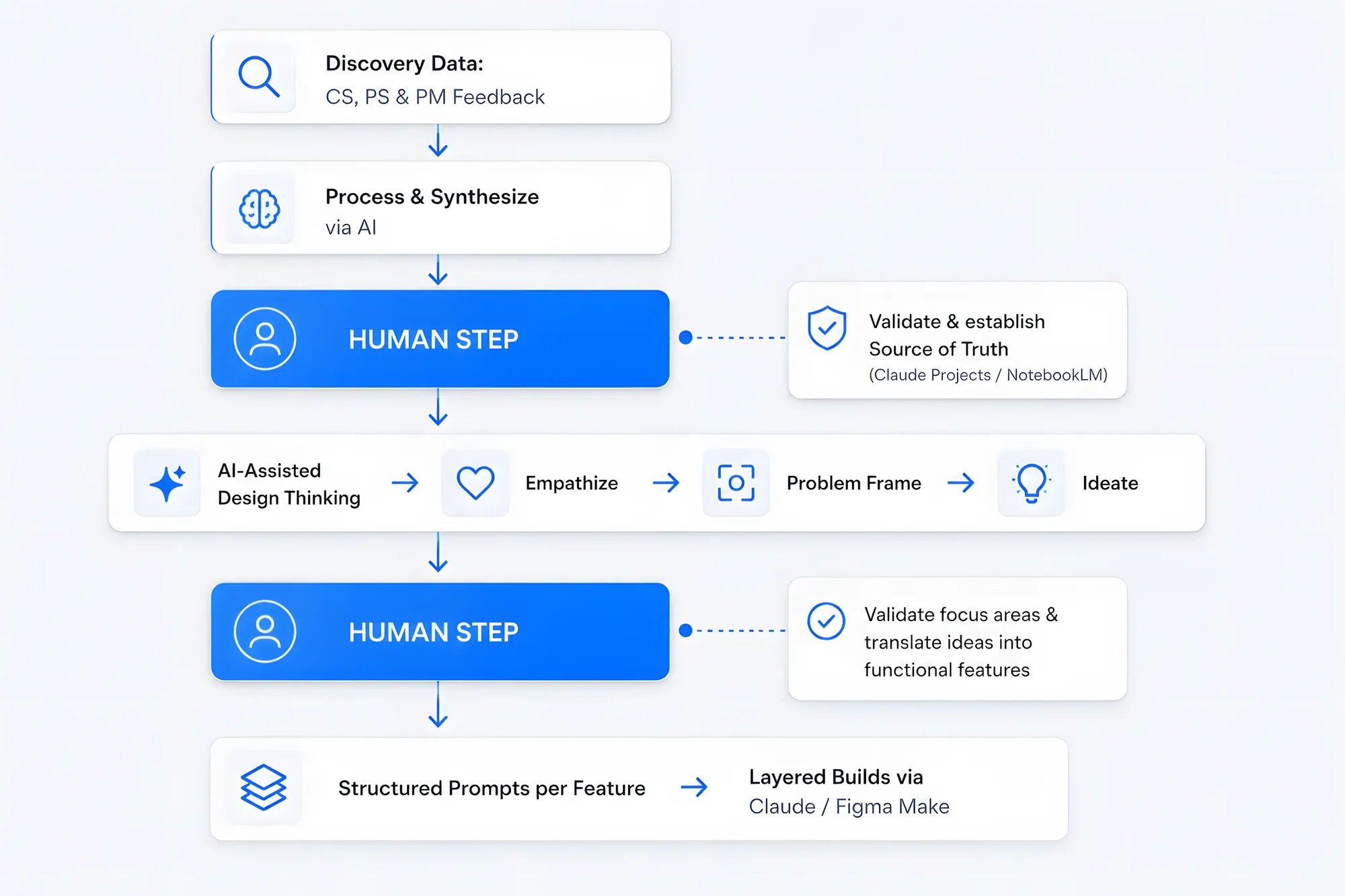
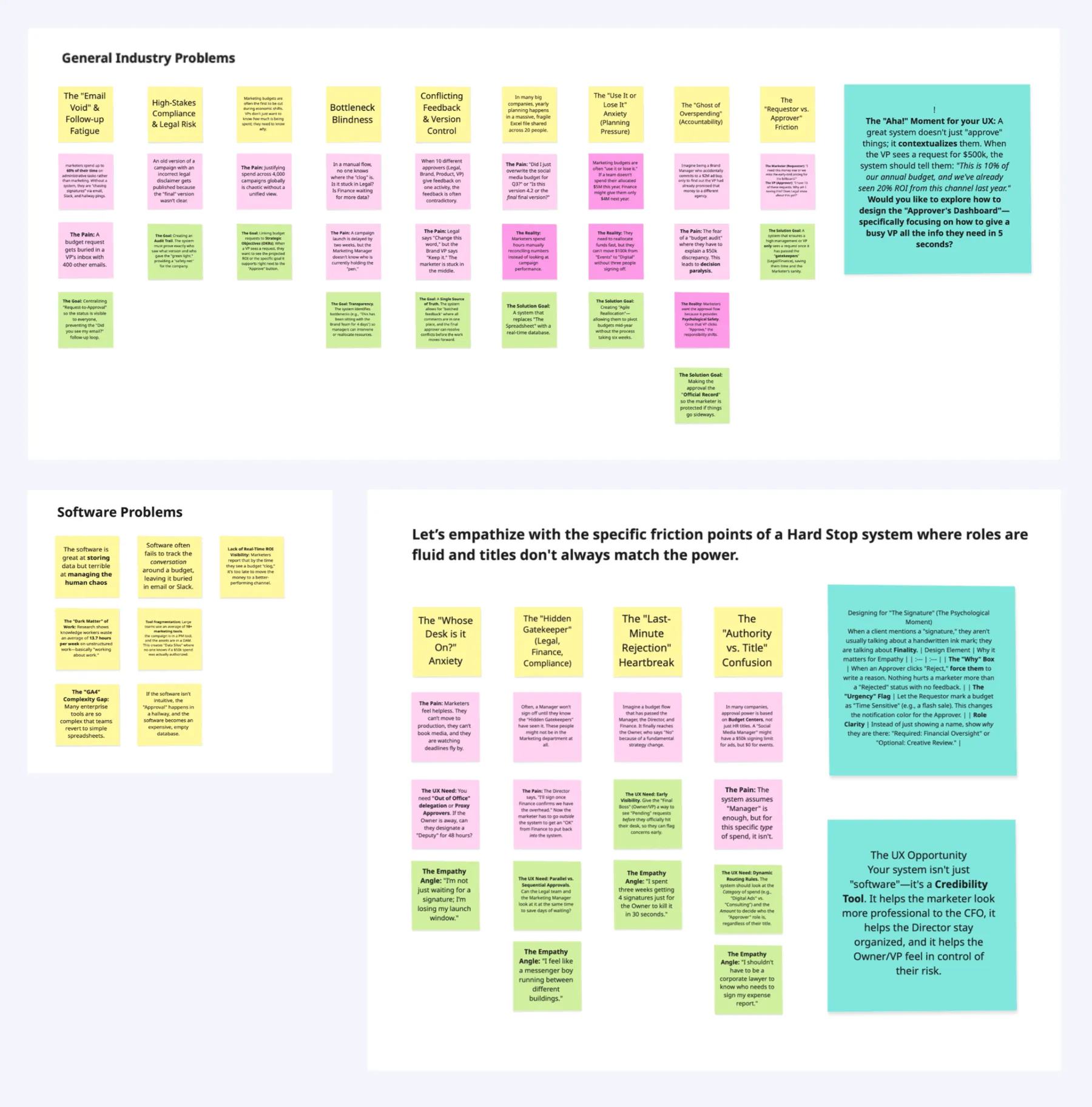
Requirements from three Tier-1 clients lacked the depth to validate an enterprise solution, and more client interviews were weeks away; to maintain momentum, I led an AI-Accelerated discovery sprint, synthesizing all internal domain expertise across Product, Customer Success, and Services to secure buy-in.
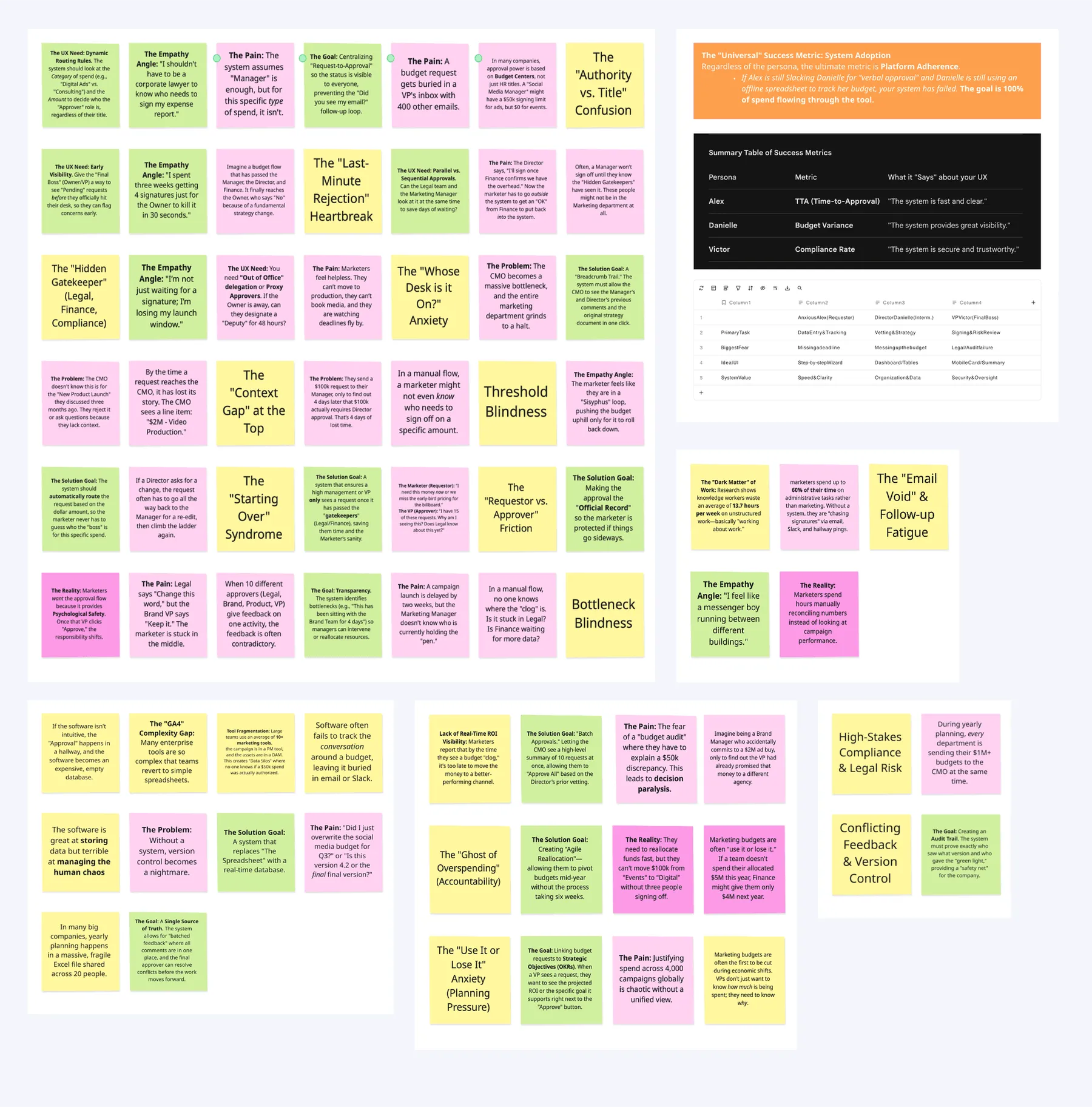
To close the gap, I synthesized all insights using an AI-assisted Design Thinking sprint to accelerate the mapping of complex edge cases, approver hierarchies, and threshold rules against internal and external industry domain expertise.
The output volume was enormous. AI is an accelerator, not an oracle — every source had to be validated and cross-referenced against our clients' actual data and our internal knowledge before it earned a place in the solution.
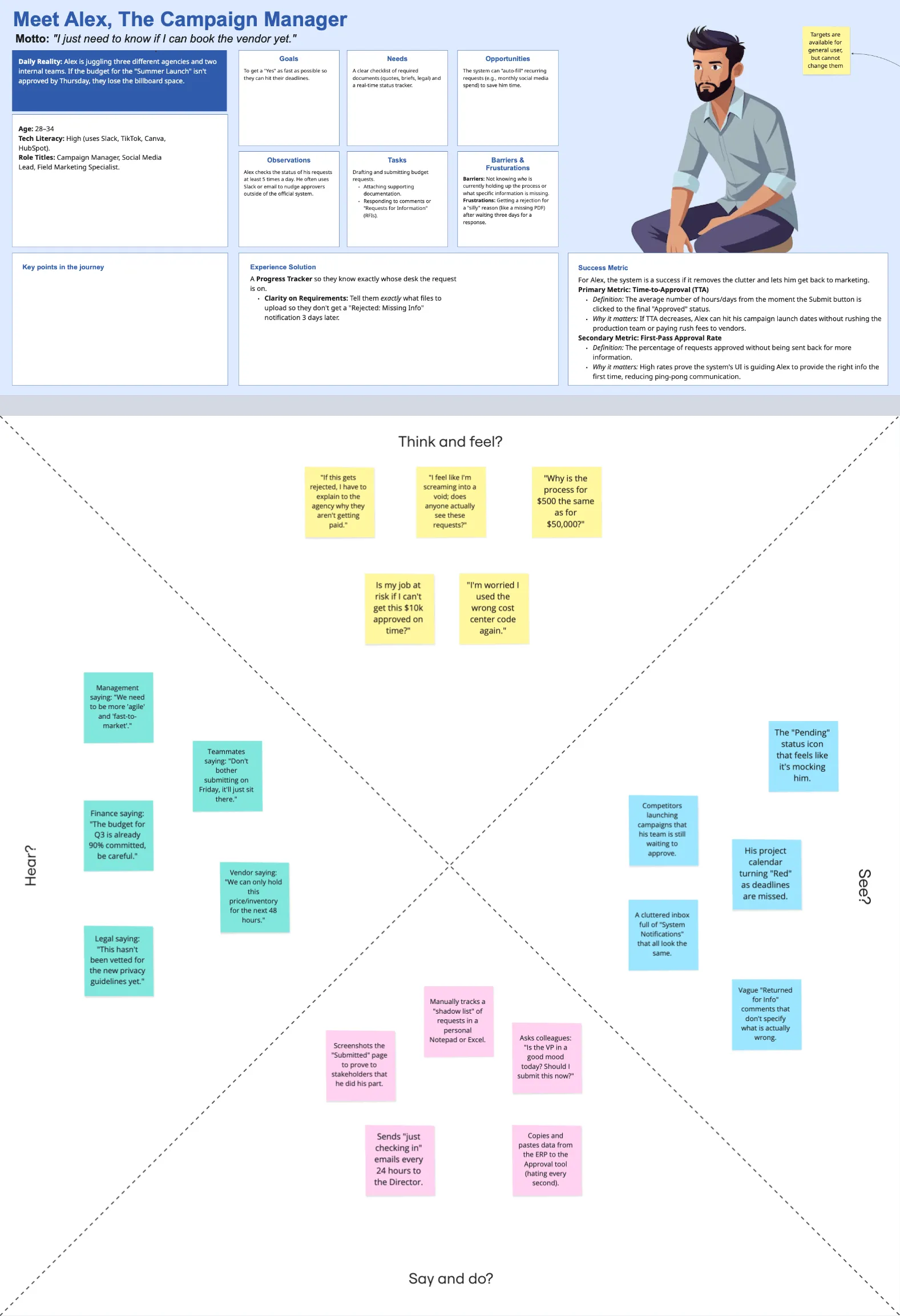
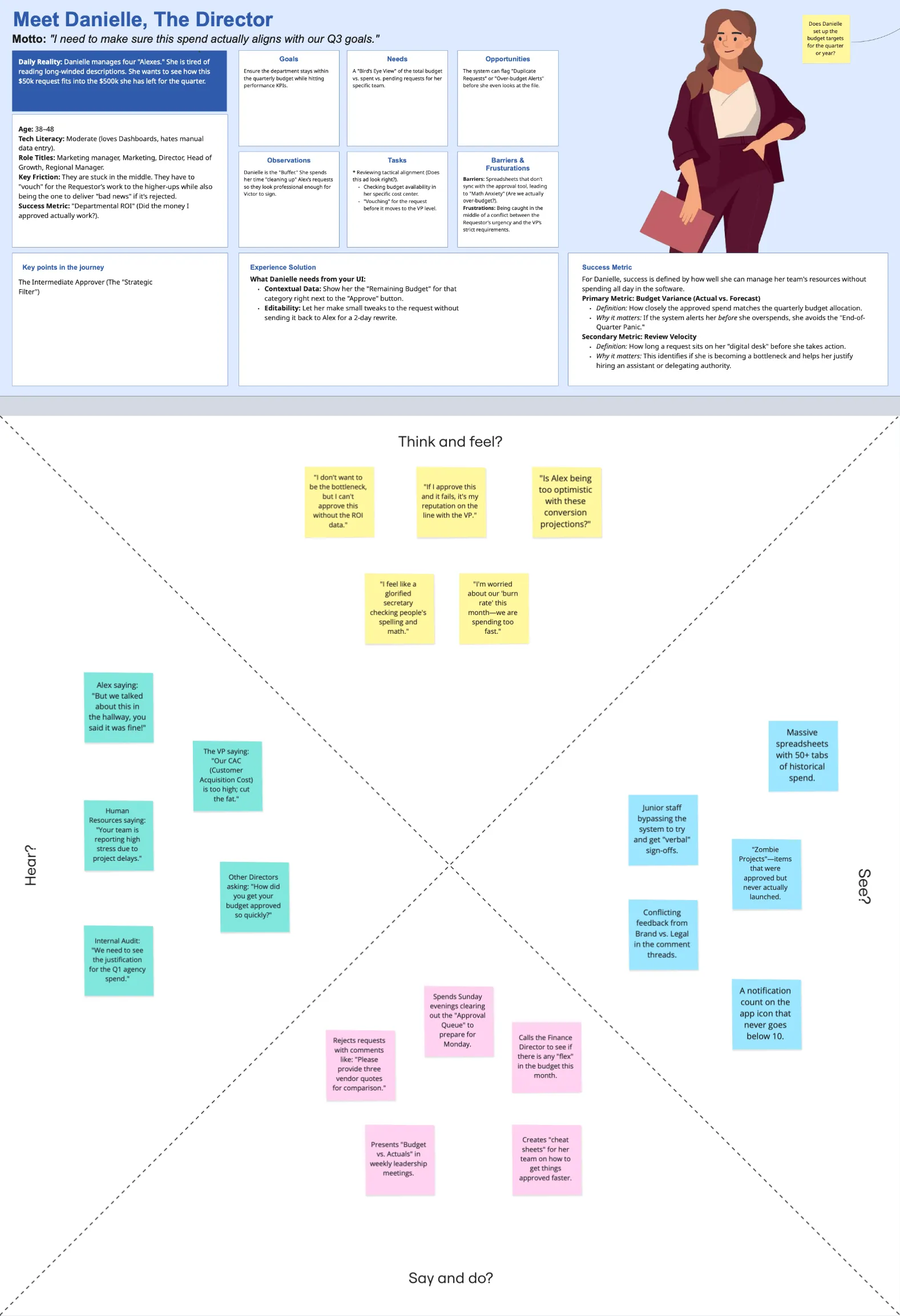
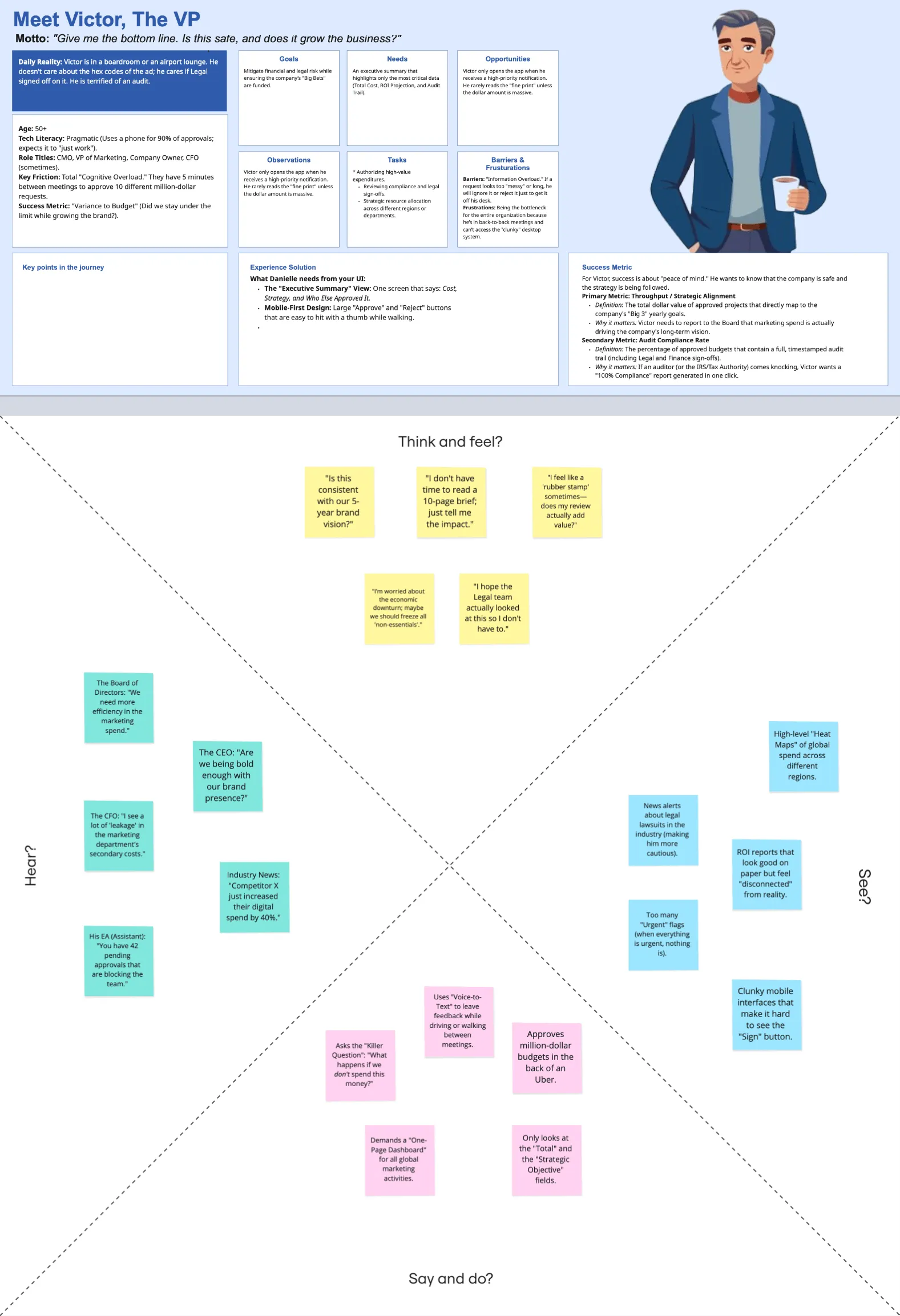
Personas & Empathy Maps
Synthesizing feedback into defined roles established our permission and visibility hierarchy. Empathy mapping then exposed the friction behind each role—from campaign manager risk during stalled requests to the specific data approvers needed for confident sign-off.
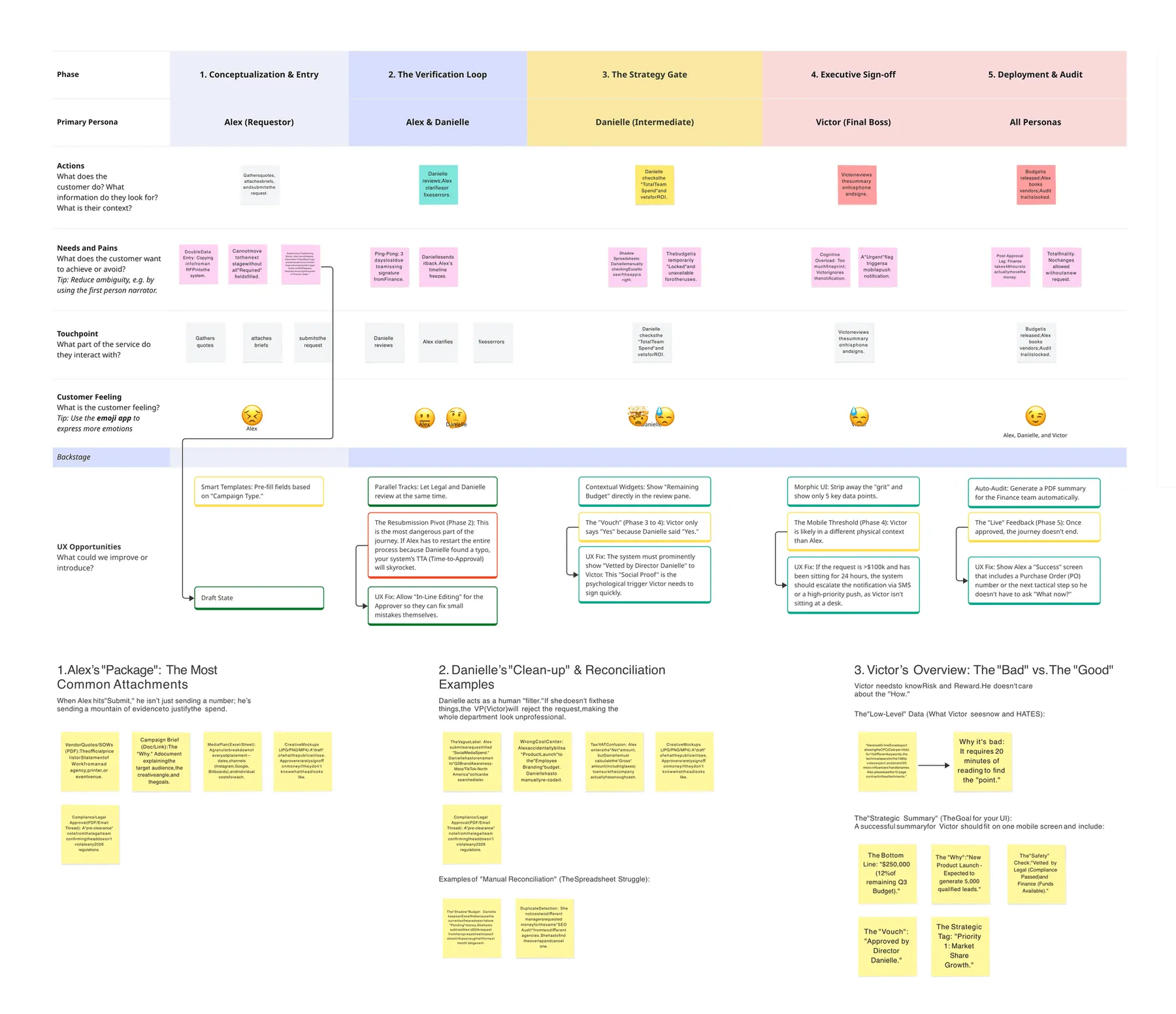
User Journey Map
Journey mapping revealed hidden cross-departmental handoffs and human bottlenecks that static roles missed. These friction points directly dictated the governance engine's touchpoints, delegation rules, and escalation logic.
Validating the direction
I validated my AI-accelerated discovery with my Financial Management counterpart; cross-checking fresh feedback against our discovery showed that mid-sized clients needed approval workflows without Tier-1 overhead.
Key insight: Rather than imposing rigid enterprise rules on everyone, we needed a configurable system where complexity was opt-in—ensuring the software scaled down as gracefully as it scaled up.
With the actors, journeys, and segment requirements established, we could draft the first approval workflow model—its logic, intersections, and touchpoints across the Uptempo platform. This is where discovery started producing structure.
4. Aligning People Before Aligning Systems
I led this initiative and succeeded in aligning all stakeholders, given that the governance engine cuts across every module of the platform: PMs had to accept changes in their areas, designers with diverse working methods had to converge on one system model, developers needed to trust what we were doing, and stakeholders had to back the direction
Bringing PMs and designers early into the process
I integrated them into discovery and solutioning rather than presenting finished work, which turned potential resistance into shared ownership. People defend what they helped build.
Making the vision tangible early
Abstract logic doesn't align anyone. System models, flow diagrams, and prototypes gave people something concrete to argue with — which is far more productive than asking them to agree in principle.
Speaking each function's language
Professional Services and Customer Success needed edge cases covered; PMs needed roadmap impact and scope discipline; stakeholders needed the business case for building a platform-wide engine instead of a client-specific feature.
5. Systemic Architecture: A Decoupled Governance Engine
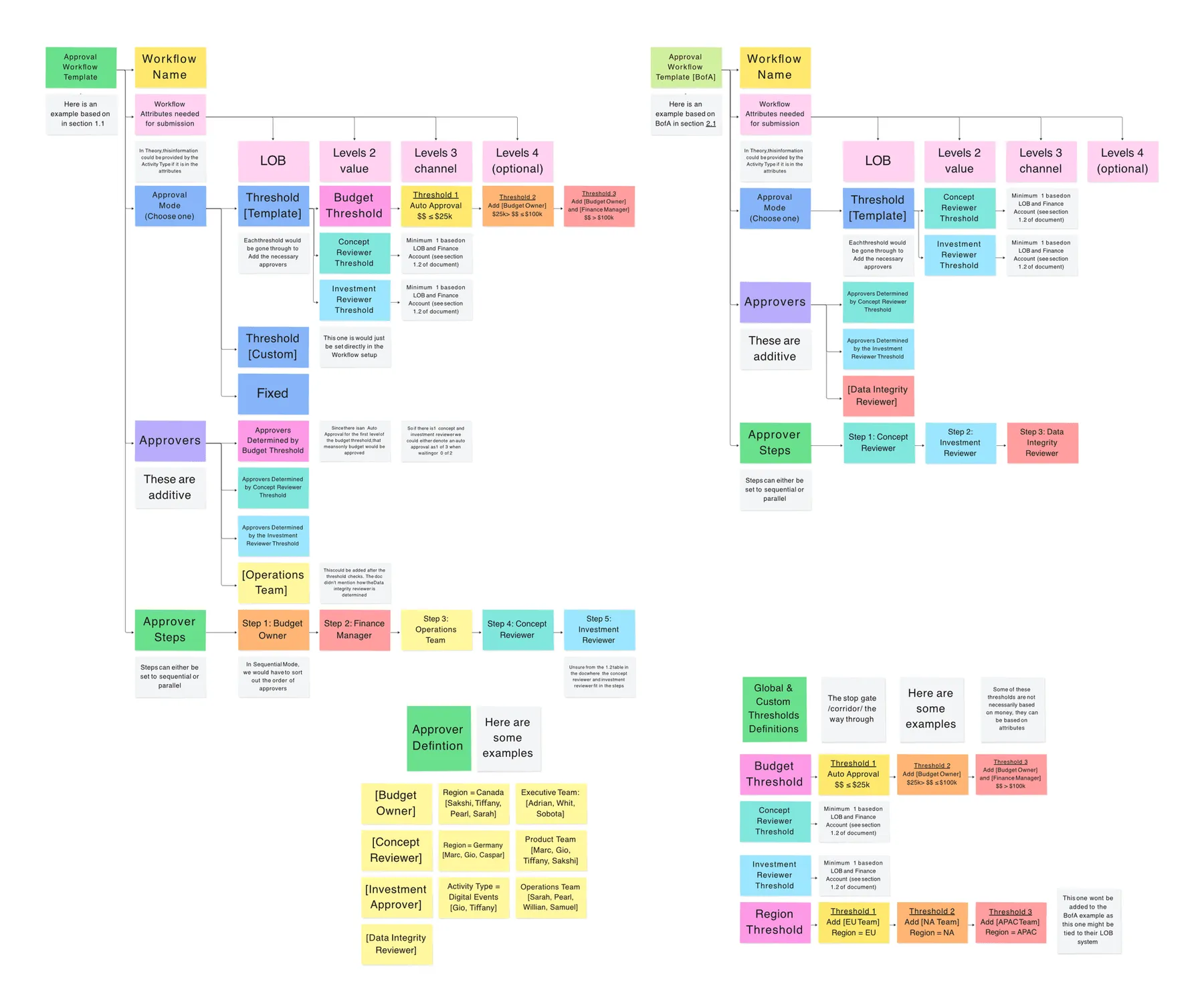
I concluded the product had to be architected as a decoupled, administrative governance engine rather than approval logic hardcoded inside individual product modules. Anything module-specific would have to be rebuilt every time governance was needed somewhere new.
Key insight: Once the problem was properly understood, the shape of the solution largely presented itself.
I architected a flexible, centralized Approval Engine that lets admins define custom workflows — building the system by identifying objects, attributes, and operations to make the product structure visible, then validating and correcting that model with PMs, Product Design, Development, Professional Services, and stakeholders.
6. Product Design: MVP with a Vision
We didn't want to release only an MVP — development needed a roadmap and a picture of where the product was going over the following six to nine months, so MVP decisions wouldn't quietly foreclose the vision.
Submitting and Reviewing a Request
Campaign managers submit approval requests directly within planning activities, attaching contextual evidence rather than isolated numbers. Requests automatically route to a role-scoped inbox, providing reviewers instant, end-to-end visibility for fast sign-off.
Gallery
Built-In Compliance and Audit Safeguards
At the volume this inbox runs — hundreds of requests a month — governance stops being about a single approval and starts being about proving, later, that the process held. Filters, an immutable history, and delegation rules exist for that.
Gallery
Setting up processes, thresholds, and approval steps
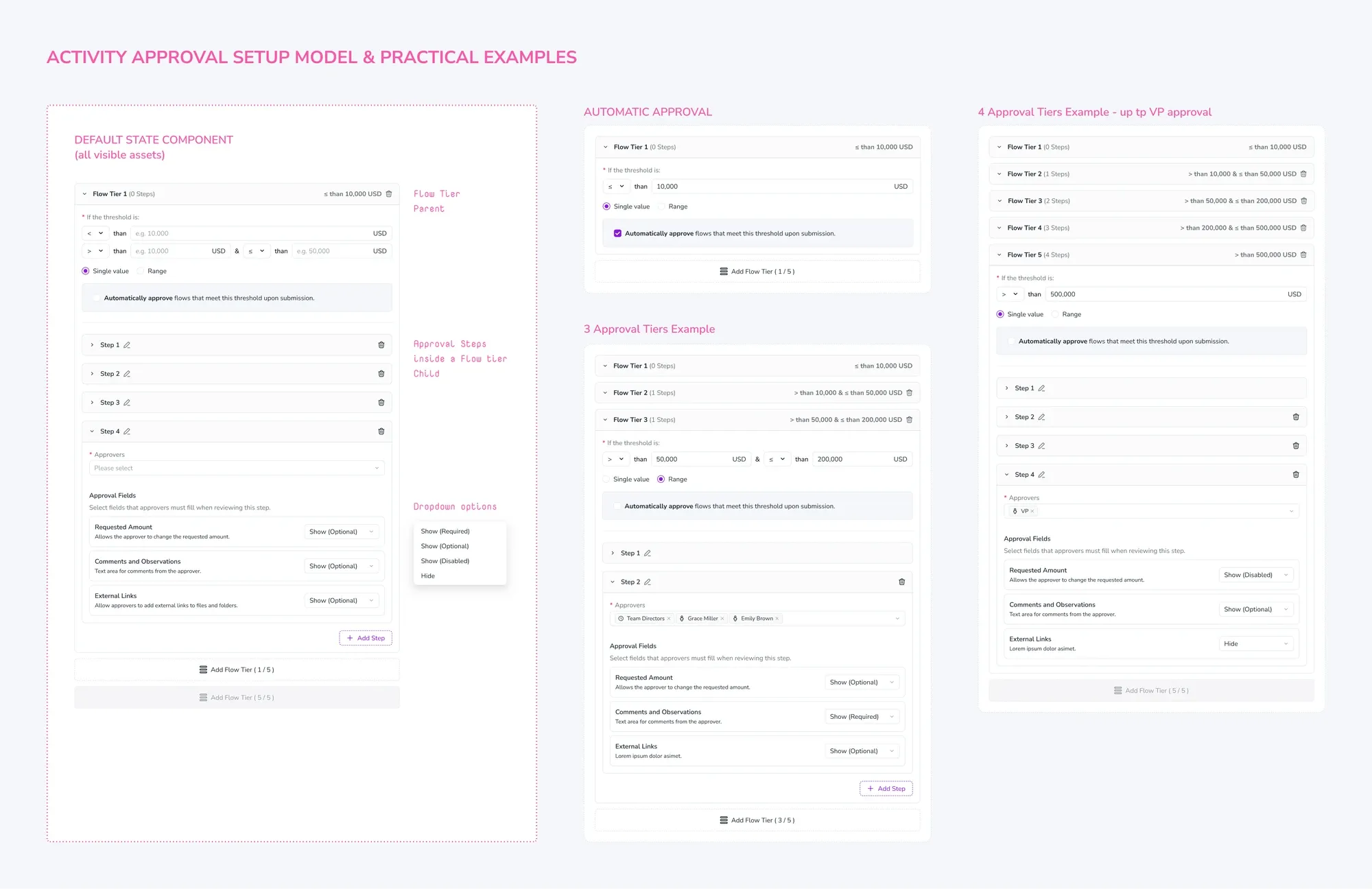
I designed a solution were each process is a flow: a threshold amount, and the approval steps required to clear it. Admins configure both — the trigger amount and the form fields each step requires — without touching code.
Customers approved this model, and the response was overwhelmingly positive—though not for long, as shown in the rest of this section—since new customer feedback would lead me to question the design.
That structure delivered two capabilities directly:
Role-Based Governance — granular approver roles bridging budget and campaign management systems that had been disconnected.
Threshold-Based Approvals — automated routing for anything crossing a defined financial limit.
Gallery
Enterprise representatives validated the initial design, but real-world usage revealed a disconnect between buyer expectations and operational reality. Approvals ran into the hundreds, breaking our process-centered architecture. A single organizational change meant updating dozens of processes individually—proving that process-level configuration couldn't survive enterprise scale.
Key insight: Client proxies represent business intent, not end-user reality. The original failed under the operational chaos of actual usage. Client proxies omit operational friction without realizing it, untangling that gap between ideal specs and real end-user behavior was the actual breakthrough.
The fix was to decouple: a process became a template
To solve this, I decoupled the workflow engine into a modular, object-based architecture. Rather than hardcoding isolated processes, we broke the system down into three reusable building blocks:
Processes as Reusable Templates: Shifted from static workflows to flexible templates mapped directly to the client's financial hierarchy—including Budgets, Cost Centers, and Marketing Activities.
Gallery
Independent Threshold Entities: Reengineered threshold rules into standalone governance objects that administrators could dynamically map and add multiple approval flows.
Gallery
Structural Scalability: Eliminating fixed threshold-to-flow bindings drastically reduced setup overhead, allowing administrators to maintain hundreds of approval rules from a single, centralized control point. This structural reframing directly translated into visual clarity. Replacing dense numeric tables with a color-coded spectrum bar made threshold tiers and approval boundaries instantly scannable at a glance.
120+ Screens and the Pragmatic Boundaries of AI
Managing scale & complexity
Delivering this engine required over 120 UI screens and state variations. I designed the vast majority manually, working through continuous client feedback loops and multi-tiered business logic.
Recognizing AI's limits in deep systems design
At this level of contextual complexity, generative AI regularly hallucinated invalid business flows or produced out-of-scope solutions.
AI as an ideation partner
For intricate workflow edge cases, generative AI can explore layout variants and break creative deadlocks, offering fresh perspectives and sparking discussion.
Knowing when to go manual
Senior judgment includes knowing when to switch AI off. I stepped out of generative workflows to map system states, edge cases, and business logic by hand — re-engaging AI only for rapid micro-iterations once the architecture was solid.
7. MVP: From Vision to First Release
With a functional MVP shipped to pilot clients for real-world testing and feedback, and the Approval Engine in active development, the response from clients was strongly positive — positive enough that others began requesting additional capabilities for future releases.
Compromises are part of any development cycle, and the administration area was no exception in this first iteration: third-party integrations via Workato held thresholds and comparable functionality in place until launch, scheduled for the third phase.
Submit approval request
The application form includes only the business case description and the deadline set by the activity owner, who can also select the approver directly in the absence of approval flows.
Gallery
A Smaller Approval Inbox, Keeping the Essentials
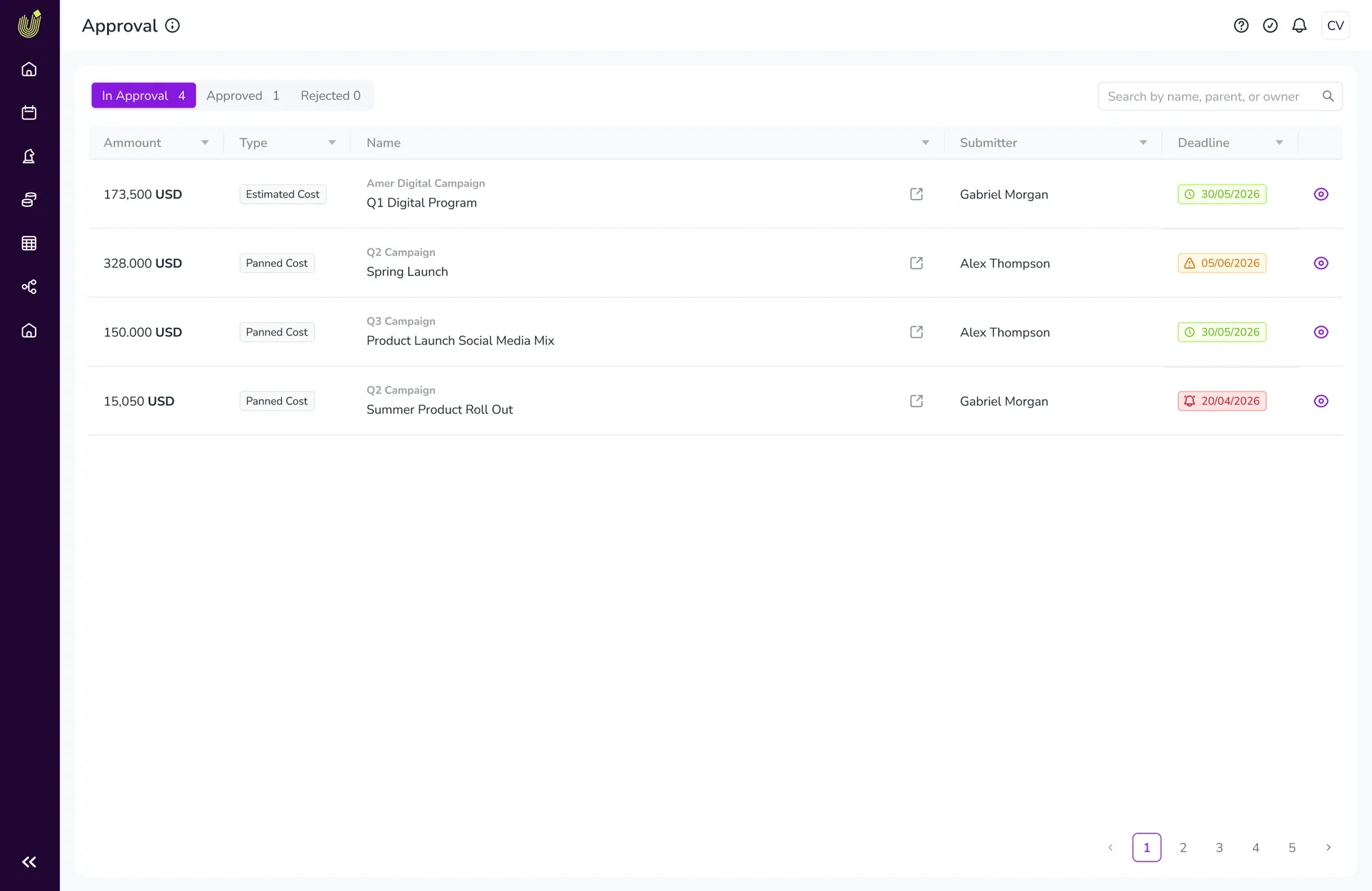
This is the same inbox from the full vision, scoped to what clients actually needed in three months rather than everything the vision allowed. It compresses an activity's lifecycle and skips its approval steps, both held back for later stages; domain scoping and layered filtering waited too, because deadline and request type were what actually let an approver sort a queue — and clients weren't blocked without the rest.
Approval process
We addressed edge cases — such as multi-quarter approvals — kept the Built-In Compliance and Audit Safeguards intact, and retained the key features needed for customer testing, with the understanding that the rest of the vision would follow in subsequent iterations.
Gallery
Key insight: Working under constraints isn't about doing less. It's about deciding, deliberately, what still delivers value to the user — and what can wait.
8. Business Impact & Outcomes
Key takeaway: Validating a product isn’t proving that three clients want it. It’s proving the hundred other clients can live with what those three asked for.
Business Impact
Objective
Solution & Execution
Impact
Key client validation
Proposed and tested a concrete approval logic (request types, configurable steps, amount thresholds) directly with Tier-1 accounts instead of waiting for written requirements
Validated demand with the accounts that triggered it. Design logic confirmed and positively received by IBM, Dell, and Porsche; feature-parity gaps identified early, before development committed
Product sustainability
Reframed the brief after discovery revealed that SME clients need approvals at far lower complexity; designed progressive configuration so the system scales down as well as up
A platform product instead of a bespoke build. One engine serves the full client base rather than three accounts, avoiding a parallel maintenance track and long-term technical debt
Architectural feasibility
Architected a decoupled governance engine — objects, attributes, and operations modeled and validated cross-functionally — rather than hardcoding logic into individual modules
Feasibility proven within existing platform constraints. Governance can be extended to new modules without rebuilding approval logic each time
PM & stakeholder alignment
Made the vision tangible early through system models and prototypes, and translated the case into each function's own language
PMs, Product Design, and stakeholders aligned behind a platform-wide strategy that existed on no roadmap — because I built the case and led the coalition that got it there
Co-creative process
Integrated PMs and designers into discovery and solutioning rather than review cycles
Shared ownership. Adjacent domain owners became advocates for the engine in their own areas, reducing downstream resistance during implementation
Commercial signal
Delivered a vision prototype and a 6–9 month roadmap alongside the MVP scope
Demand beyond the existing client base. The engine surfaced as a deciding capability for prospective clients evaluating the platform — among them Bank of America — contingent on it becoming operational
Delivery readiness
Designed 120+ screens and state variations, including delegation, escalation, and immutable audit-trail logic
MVP shipped to pilot clients for real-world testing
Learnings & Reflections
The strongest lesson from this project had nothing to do with approval logic. It was that when you're handed a feature name instead of a problem, the temptation is to start designing immediately — and that is exactly the wrong move. The time invested in understanding why three different enterprises wanted governance, and what the other hundred clients could actually absorb, produced an architecture that held.
Design Thinking is often described as a process for generating solutions. In my experience, it's the opposite: it's a process for earning a correct problem definition. Once we genuinely understood the problem, the solution largely presented itself — the decoupled engine wasn't a creative leap; it was the only answer that survived the constraints we had mapped.
The second lesson was about leadership. Leading a product end-to-end meant building the case for it, forming the coalition behind it, and treating alignment as part of the design work itself — not a communication task tacked onto the end.
“Leadership was the real work. The system model was the easy part — getting the people who had to live with it to move together was not.”