Uptempo is a B2B SaaS platform for centralized enterprise financial marketing operations, planning, budgeting, execution, and measurement, used by global enterprises like Porsche, Estée Lauder, Amazon, and IKEA.
This case shows how a pragmatic design approach untangled inherited architectural limitations and stalled decisions, aligned cross-functional Teams and stakeholders, and restored critical administrative capabilities to secure high-value enterprise accounts at risk of churn.
Case Metadata
Role
Senior Product UX Designer (with cross-functional PO responsibilities and Interim PM execution)
Scope
Enterprise B2B SaaS platform — post-merger integration of BrandMaker, Allocadia, and Hive9
Timeframe
March 2025 – April 2026 (14 months)
Cross-functional reach
3 Product Managers, 2 Product Designers, a 6-person development team, and stakeholders spanning leadership, Professional Services, and Customer Success
Core Challenge
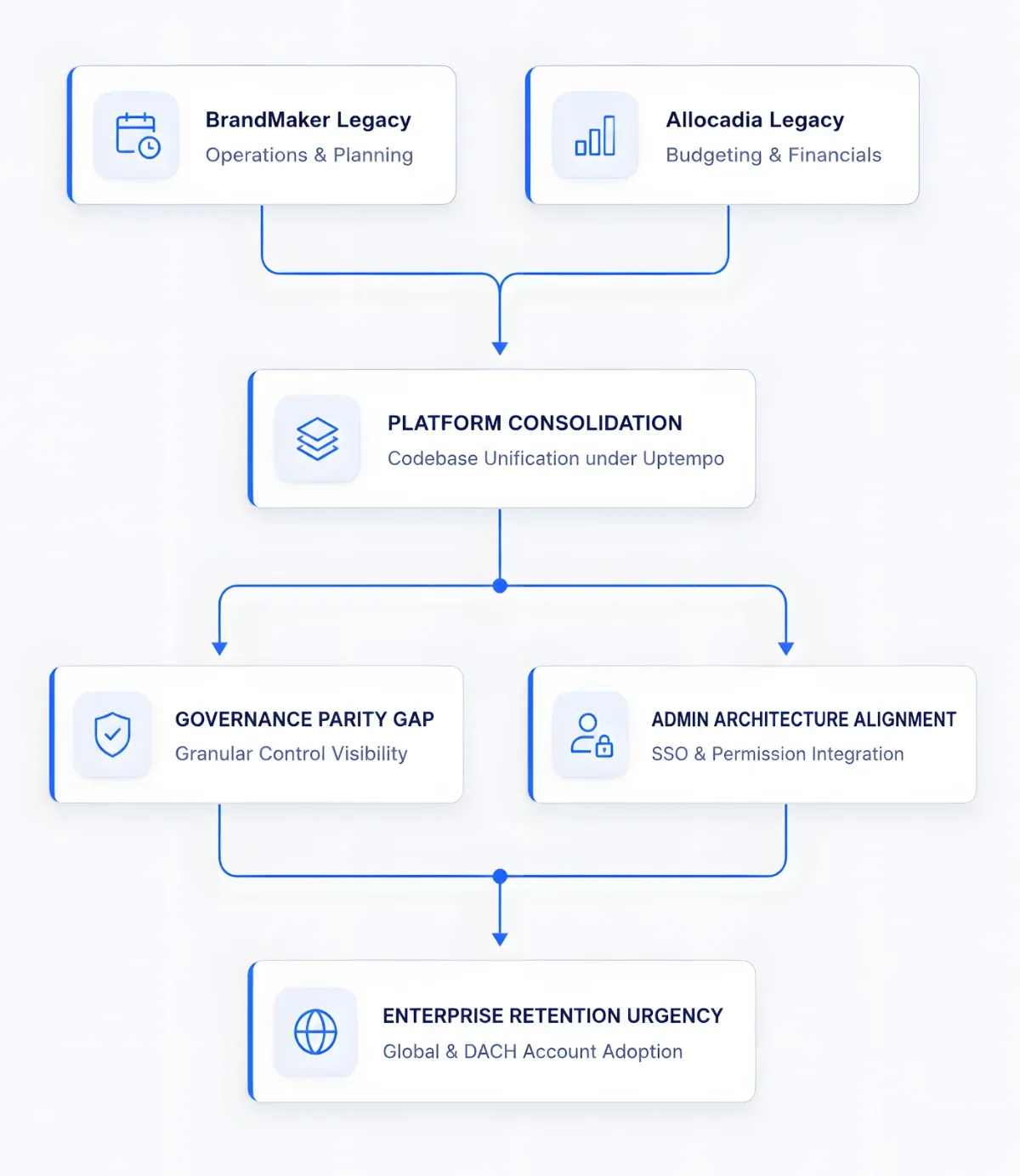
Post-merger platform consolidation, a low-flexibility platform interface, feature parity gaps, administrative architecture alignment, and customer retention urgency — under compounding schedule pressure
1. Post-Merger Integration: High Stakes, No Margin for Disruption
I was part of the BrandMaker product team when BrandMaker GmbH, Allocadia, and Hive9 consolidated under the Uptempo brand to build a unified Enterprise Marketing Operations platform. Our task was to bring BrandMaker's and Allocadia's distinct, mature architectures together — unifying separate data models and administrative structures into one platform without disrupting client operations already running on them.
Both were mature, robust, and functional enterprise software solutions built around financial workflows that global marketing organizations had trusted for years. Their visual language reflected the era in which they were created.
The platform layer
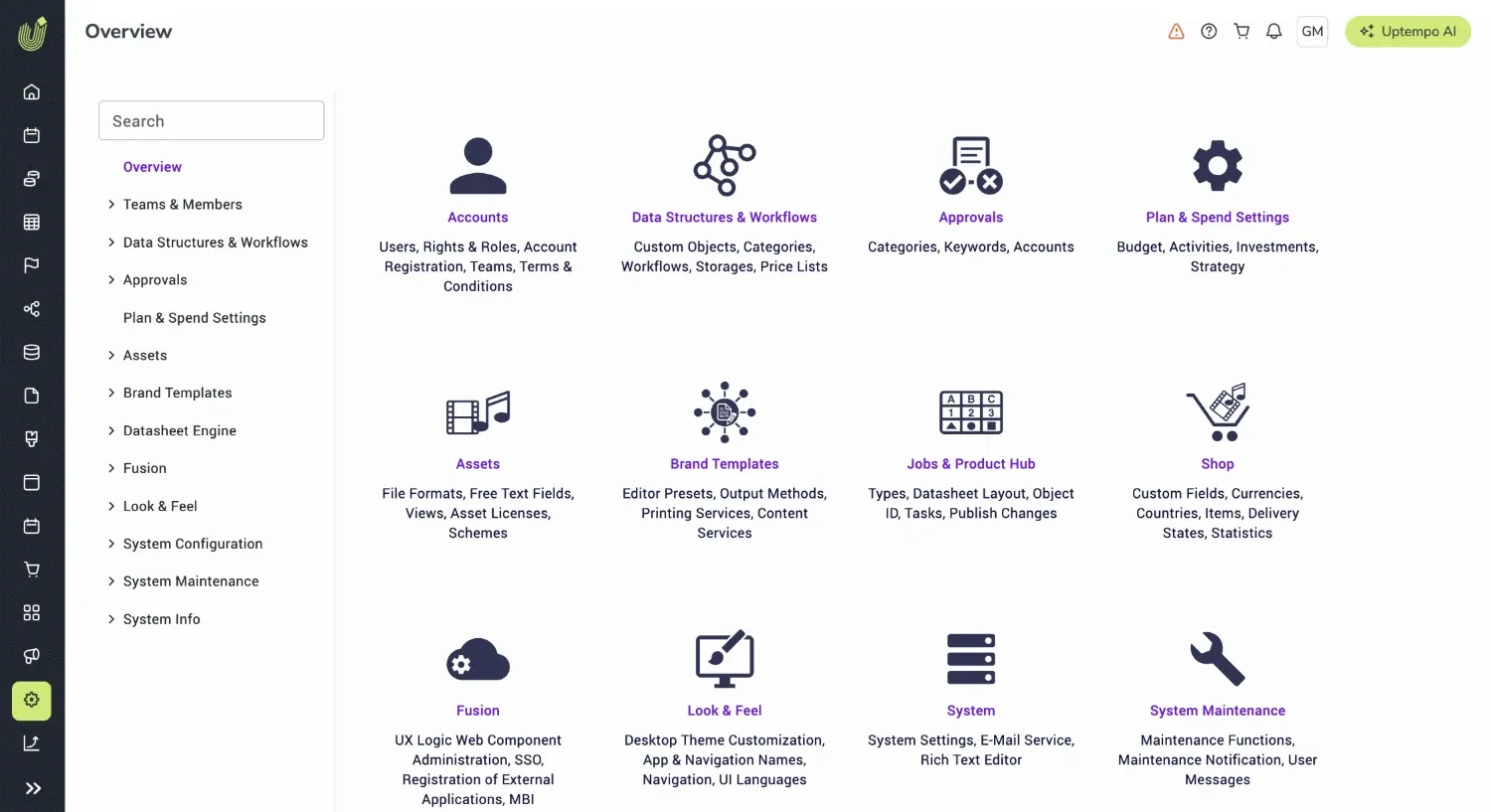
I was given ownership of the platform layer. Neglected for years, with controls scattered between individual modules and the central administration area, so routine admin tasks crossed three parts of the product.
Conversations with Professional Services and Customer Success revealed that functionalities enterprise clients rely on stopped working without warning, putting them at risk.
Governance & visibility gaps — consolidation left enterprise clients without granular data visibility and administrative permissions.
Systemic usability friction — harmonizing historical behavioral differences extended administration time for client admins.
Trust in regulated markets — clients in DACH in particular required full compliance and administrative parity.
Assessment: The risk was not that the interface looked dated; it's that something users depend on quietly stops working.
Key insight: People assume that bringing two platforms together is a UI and architecture problem. It isn't navigating distinct cultures, conflicting workflows, and strong emotional ownership over legacy systems—aligning these people dynamics must happen before any design framework can succeed.
2. Stepping as Interim Product Manager
While the platform domain waited on a new permanent PM, I stepped into the Interim Product Manager role for three months — the highest-stakes phase of the transition.
I freed engineering for high-priority governance capabilities,
I led a resource reallocation and cancelled three non-essential projects, redirecting capacity toward core enterprise enablement.
I aligned with Product Management and Product Design; we settled on an iterative MVP strategy focused strictly on immediate time-to-value.
My Strategic Approach
AI-accelerated workflows
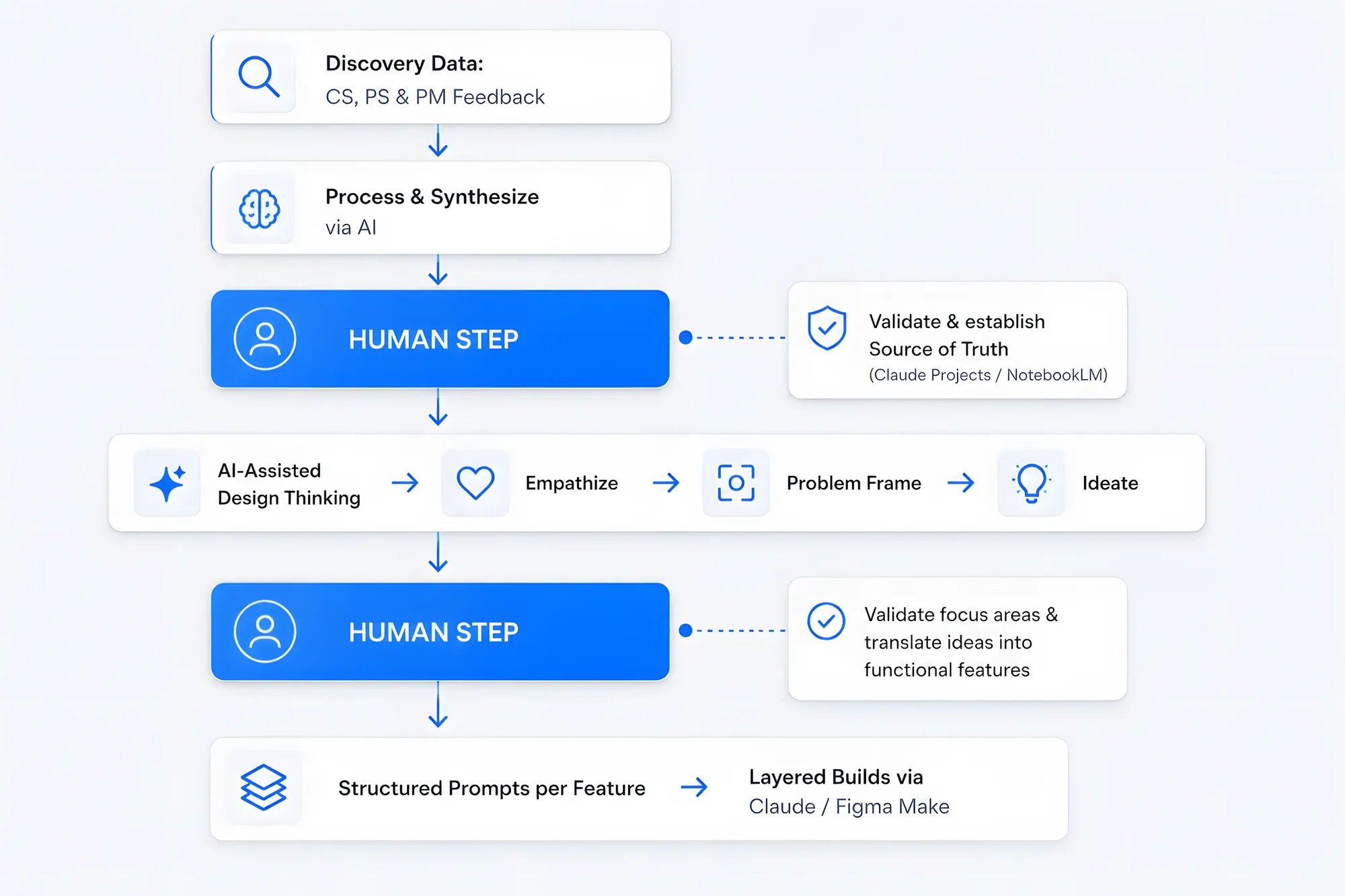
AI-driven synthesis compressed research, problem framing, and market benchmarking from weeks to days — and turned that speed directly into delivery-ready assets: user stories, prototypes, PRDs.
Fierce MVP
scoping
I rigorously protected the scope, cutting "nice-to-have" UI polish in favor of administrative group structures and data governance visibility.
Think before
doing
As problems compounded week over week, I advocated for product design to shift away from undirected Figma exploration toward a written-first model — frame the system logic and requirements before touching the canvas.
Structured AI Design Thinking Workflow
I built this for exactly the situation I was in: very little input—or data scattered across different departments—and a clock running out. It gave discovery a repeatable structure that didn't depend on scheduling availability I no longer had — becoming the discovery backbone for my Uptempo discovery workflow from then on.
Design thinking AI-assisted Design Thinking workflow for product discovery and quick prototyping.
Leadership in the "Messy Middle"
My primary responsibility was keeping stakeholders, product leads, and developers aligned, including when hard decisions met resistance.
Direct client engagement
we met enterprise clients directly to address migration concerns about missing legacy capabilities. In high-stakes enterprise workflows, functional utility, predictability, and governance always precede aesthetic form.
De-risking engineering
involving developers early in discovery lets us stress-test legacy feasibility before writing user stories or code. Enabling engineering as an active partner in the co-design process.
Emotional intelligence
I mediated roadmap trade-offs between leadership's expectations, PM requirements, and engineering's technical limits, holding team trust together under tightening deadlines.
3. Out of Runway: How AI Bought Us Back Time
Stakeholder indecision, client-discovery bottlenecks, and stalled cross-team dependencies quietly ate away our schedule—by the time direction was settled, the runway for traditional research and validation was gone.
The Solution: I pivoted to a pragmatic "Ship First, Validate In-Market" strategy — grounding decisions in platform, industry patterns and domain knowledge instead of interviews, deploying functional MVPs straight to production, and stripping layouts to what engineering could implement within legacy constraints.
I made this decision because the question was no longer How do we validate this properly? But how do we ship responsibly when validation is no longer affordable?
Key insight: This was a deliberate trade: higher risk of post-release iteration, accepted by all stakeholders and named openly, in exchange for capability in front of clients while it still mattered.
AI-Ready Prototyping Approach
To recover the lost time, I bypassed traditional workflows and paired Claude, my front-end background, and the Figma MCP integration to rebuild our design system directly into code. This proved that when guided by domain expertise, generative AI functions as a controlled, code-accurate prototyping force rather than producing unguided "visual slop."
Gallery
This was the result: an exact, LEGO-like replica of our Figma components, assembled into development-ready, testable prototypes that cut turnaround dramatically on medium-scale initiatives.
4. Key System Solutions Implemented
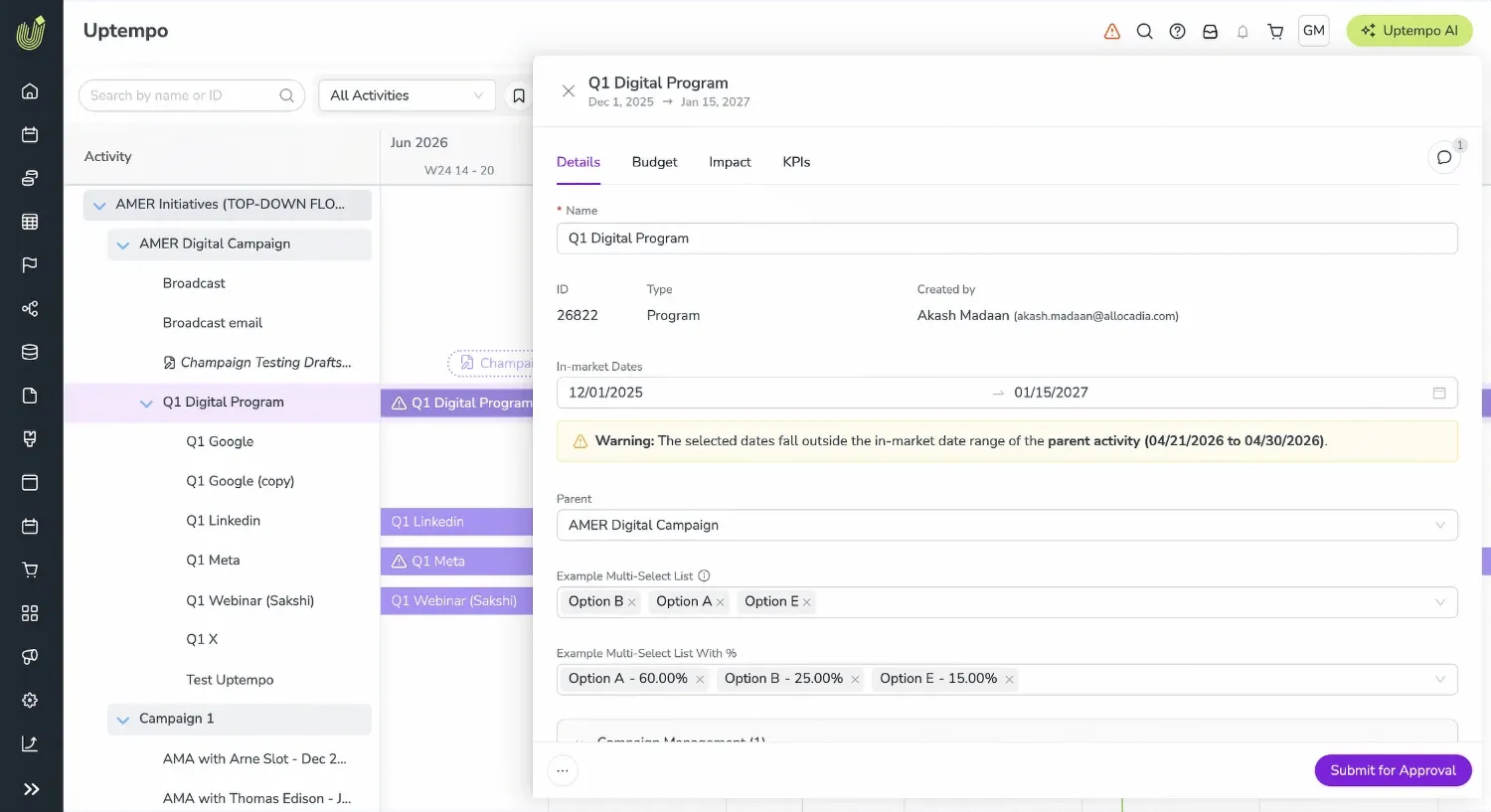
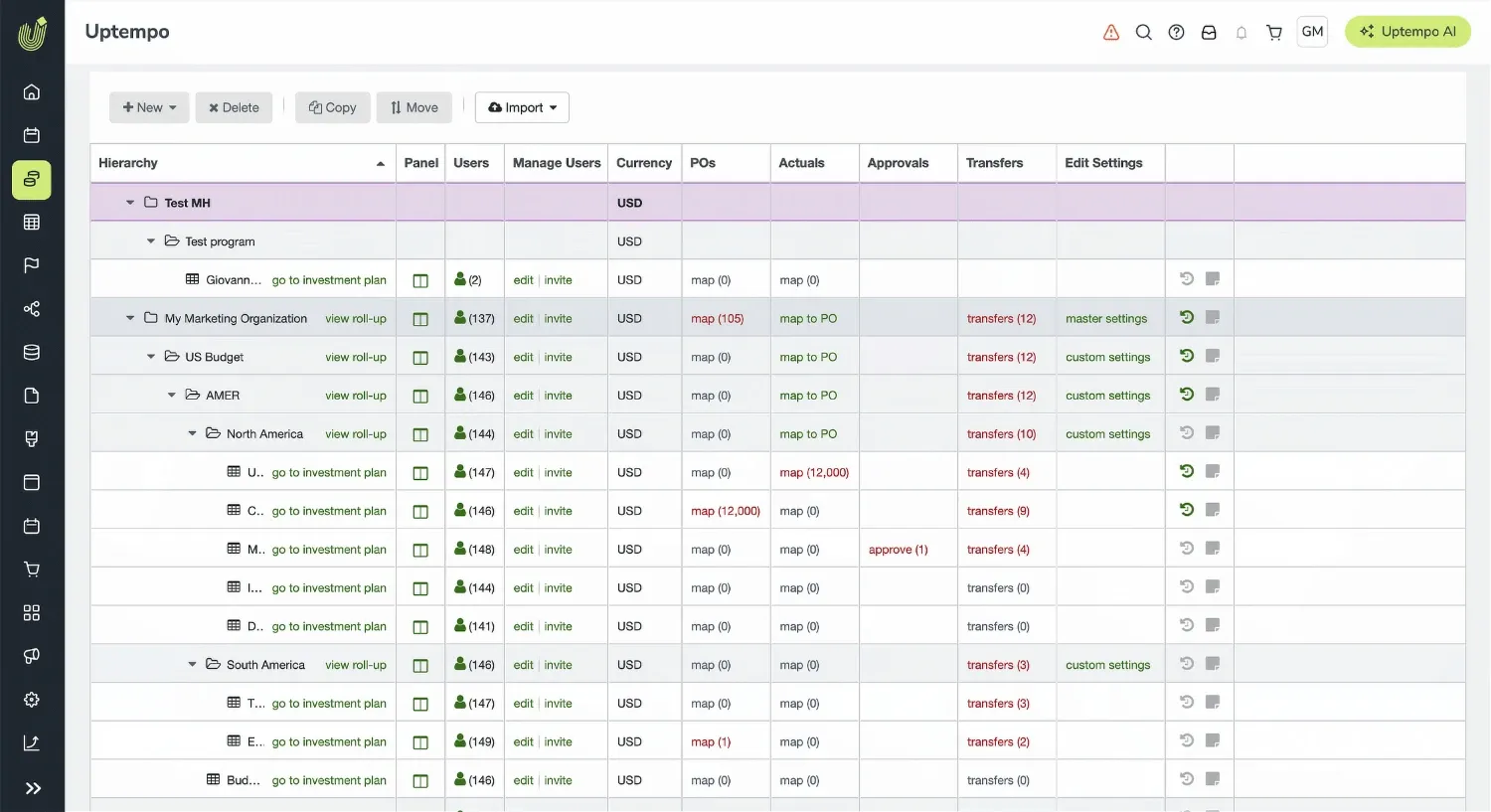
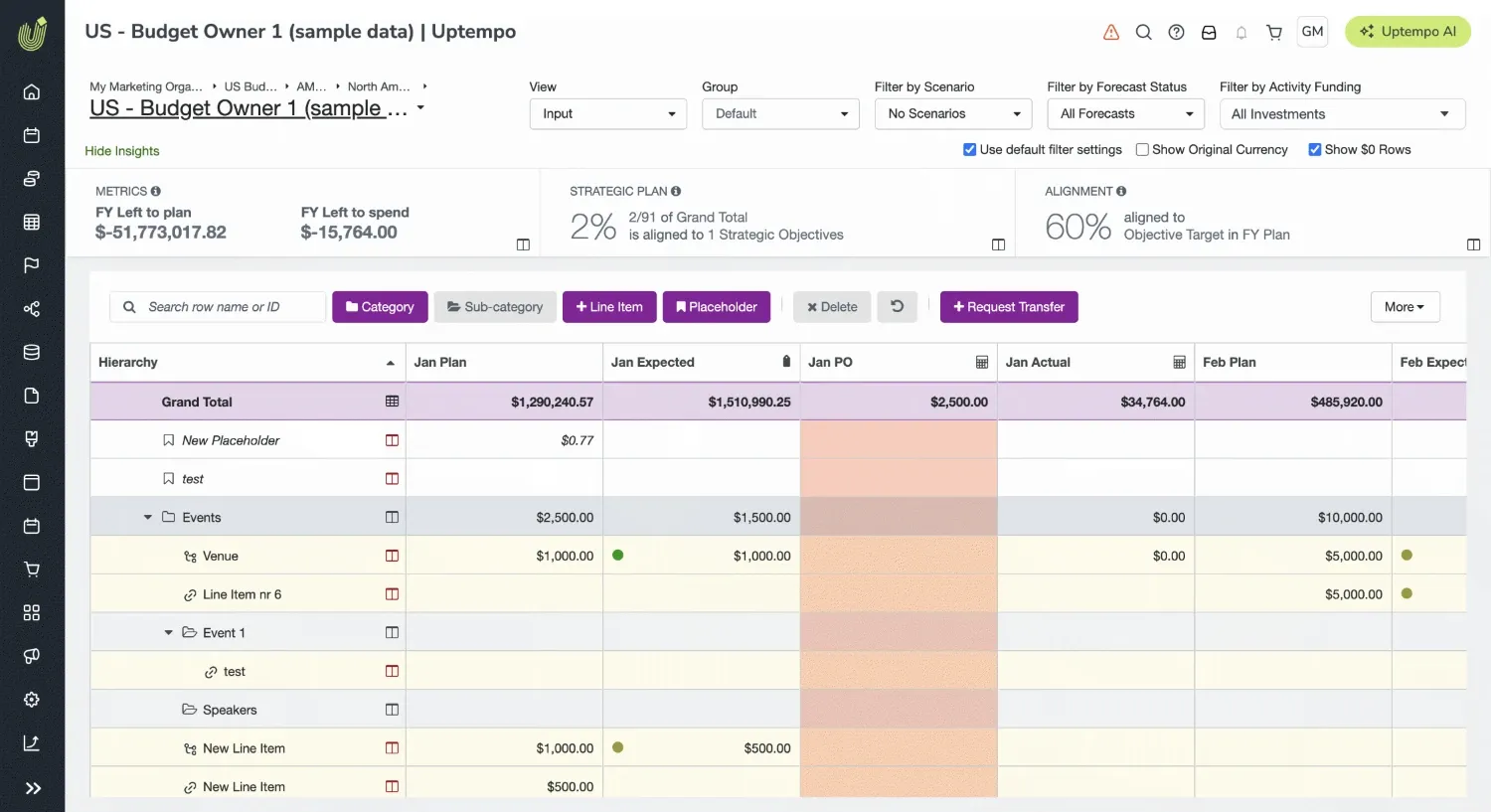
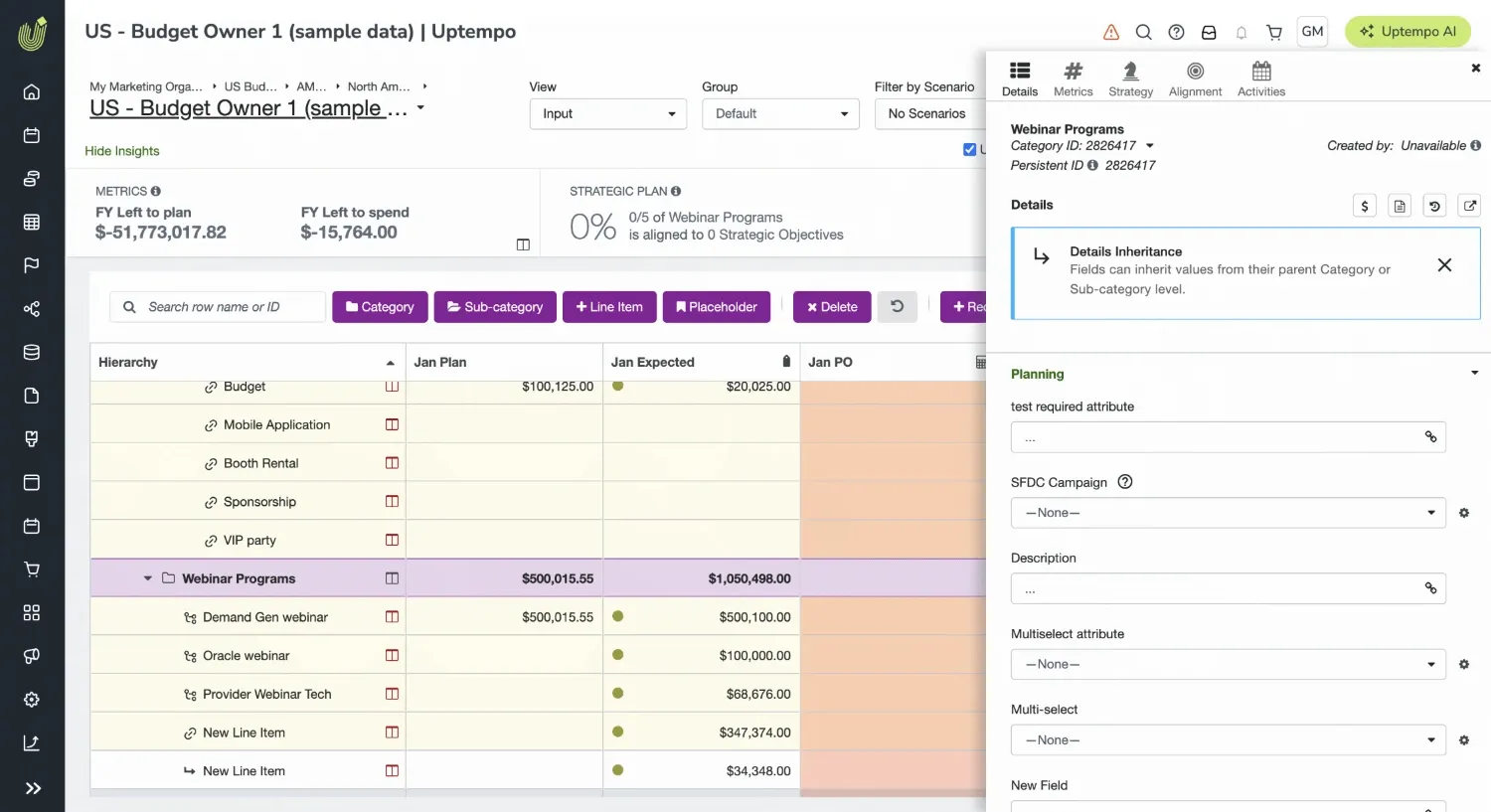
With the component library rebuilt and under my control, the pieces were finally in place to move from prototype to platform — one system solution at a time. The screens display our production user interface, but the true value lies in the strategic UX architecture, the integration of AI into our workflow, and the team's alignment behind it all.
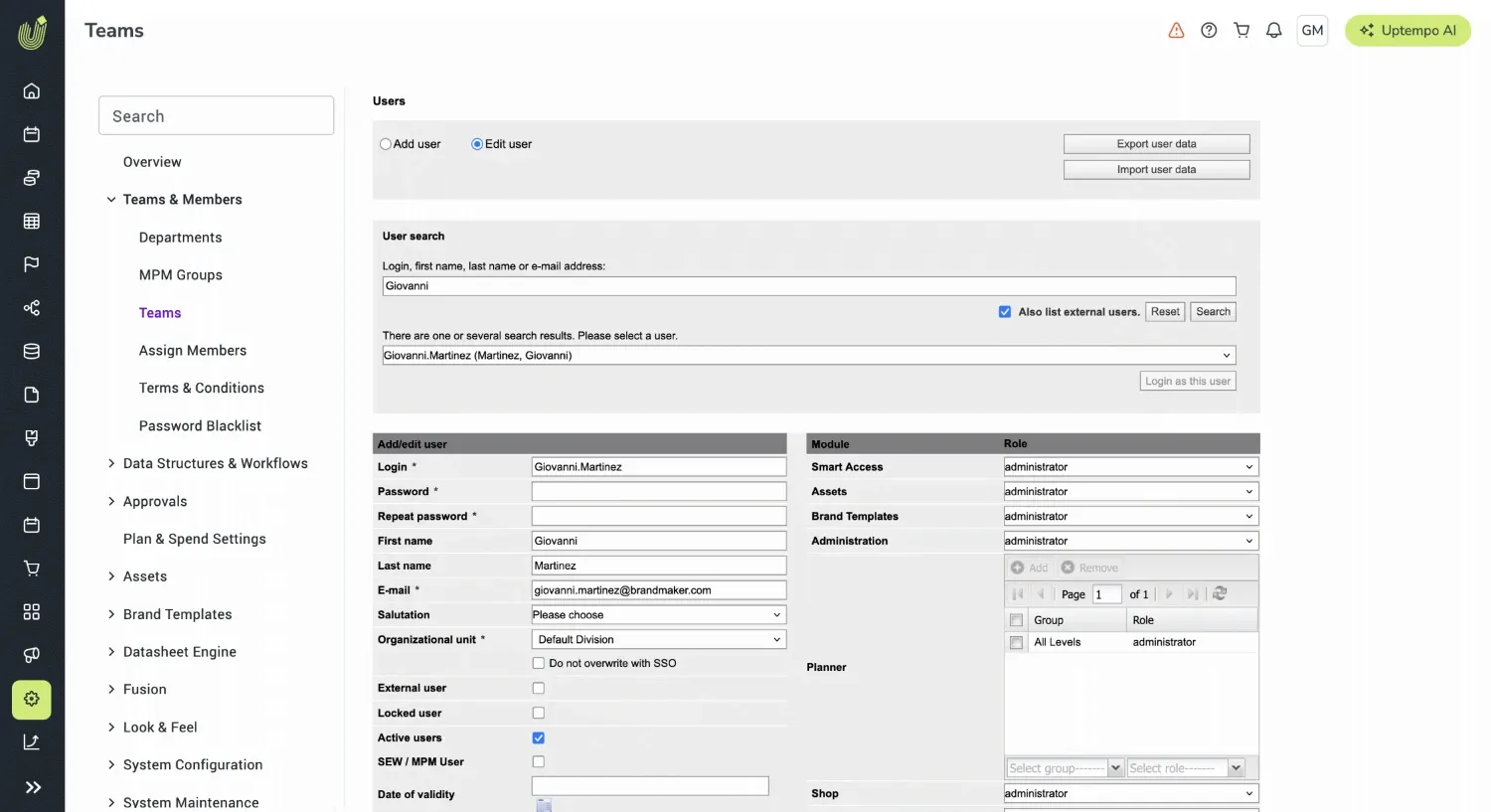
User Management Ecosystem
The Problem — enterprise administrators in the BrandMaker (DACH) ecosystem relied on proven administrative controls — assigning roles and permissions, maintaining organizational visibility. As platforms consolidated, re-architecting these governance controls became a top priority for client confidence and long-term retention.
The Solution — rather than patching short-term for legacy BrandMaker workflows, we designed a forward-compatible user management architecture that met immediate DACH governance needs while establishing a scalable foundation for the combined platform.
Gallery
Capabilities Restored: centralized user lifecycle management, role-based access control (RBAC) mapping, permission structures, and regionally privacy-compliant oversight across complex multi-entity accounts.
Single Sign-On (SSO) Groups
The Challenge — Upgrading legacy BrandMaker clients depended on restoring granular SSO team hierarchies — against tight deadlines and unresolved stakeholder direction.
The Solution — I used AI-assisted prototyping (Figma Make) to explore structural variations rapidly. Putting concrete options in front of people broke the deadlock: PM and key stakeholders aligned within a single day, and we validated and handed off the complete design spec within a week.
Pragmatic Workaround — To bypass core infrastructure bottlenecks, we partnered with PMs to leverage Workato third-party integrations, saving significant development effort.
Gallery
Capabilities Restored: Automated user provisioning via Identity Providers (IdP), central access control mapping, granular SSO group permissions, and unified cross-platform team hierarchy management.
From User Management to Self-Service
The Problem — Enterprise accounts — HubSpot among them — had no native visibility into whether licensed seats were actually being used, relying on manual GoodData/Excel exports that were being sunset. Admins needed actionable usage metrics (session frequency, time-in-tool, cost-center allocation) to reclaim inactive seats under strict license caps.
The Solution & GDPR Trade-off — Modern admin tools require actionable data, not static user lists, so we moved from traditional user management into active governance dashboards. When individual behavioral tracking collided with EU GDPR requirements, we introduced a feature-flag architecture — enabling granular tracking for US clients immediately while suppressing behavioral tracking in the EU pending legal review. Instant business value for US accounts, no European compliance exposure.
Gallery
Capabilities Restored: Real-time license utilization visibility, active seat harvesting and reallocation, cost-center allocation tracking, and GDPR-compliant regional privacy controls via feature-flag toggles.
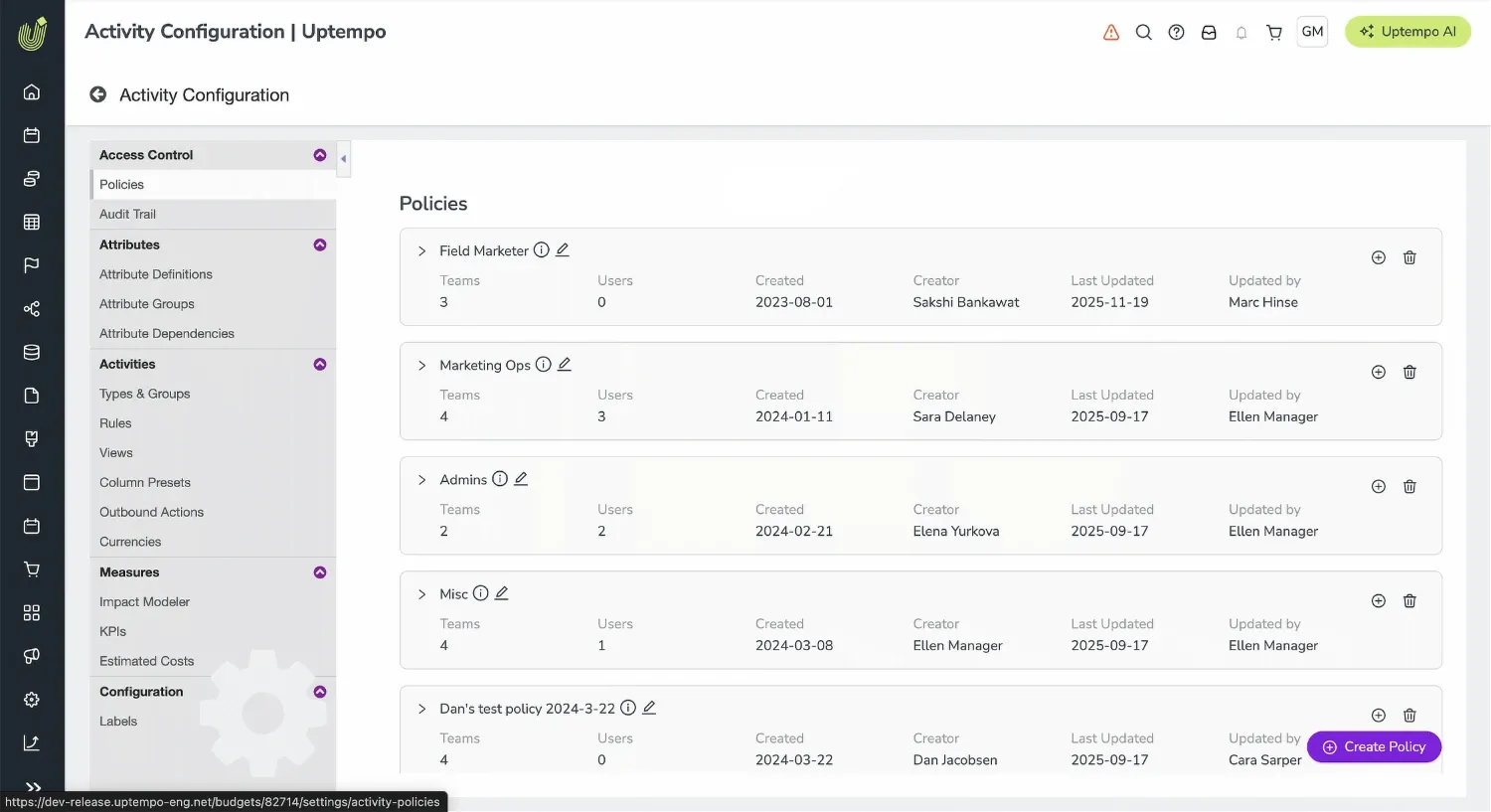
Centralized Notification Center
The Problem — a vital legacy BrandMaker capability, needed across Campaign and Financial modules. For BrandMaker clients, this was recovering something lost; for Allocadia clients, it was a capability they had never had. For us, it was a must, as the Governance Engine project depended 100% on being able to restore in-app notifications.
The Solution — Customer Success wanted granular, role-based activity controls that exceeded available story points and what could be delivered within the time. We led the trade-off decision to ship an iterative MVP grounded in market standards — delivering core functionality within sprint budget instead of chasing a perfect product at launch.
Gallery
Capabilities Restored: System-wide event triggering, customizable in-app and email alert rules, role-based event subscriptions, and real-time activity status visibility across campaign and financial modules.
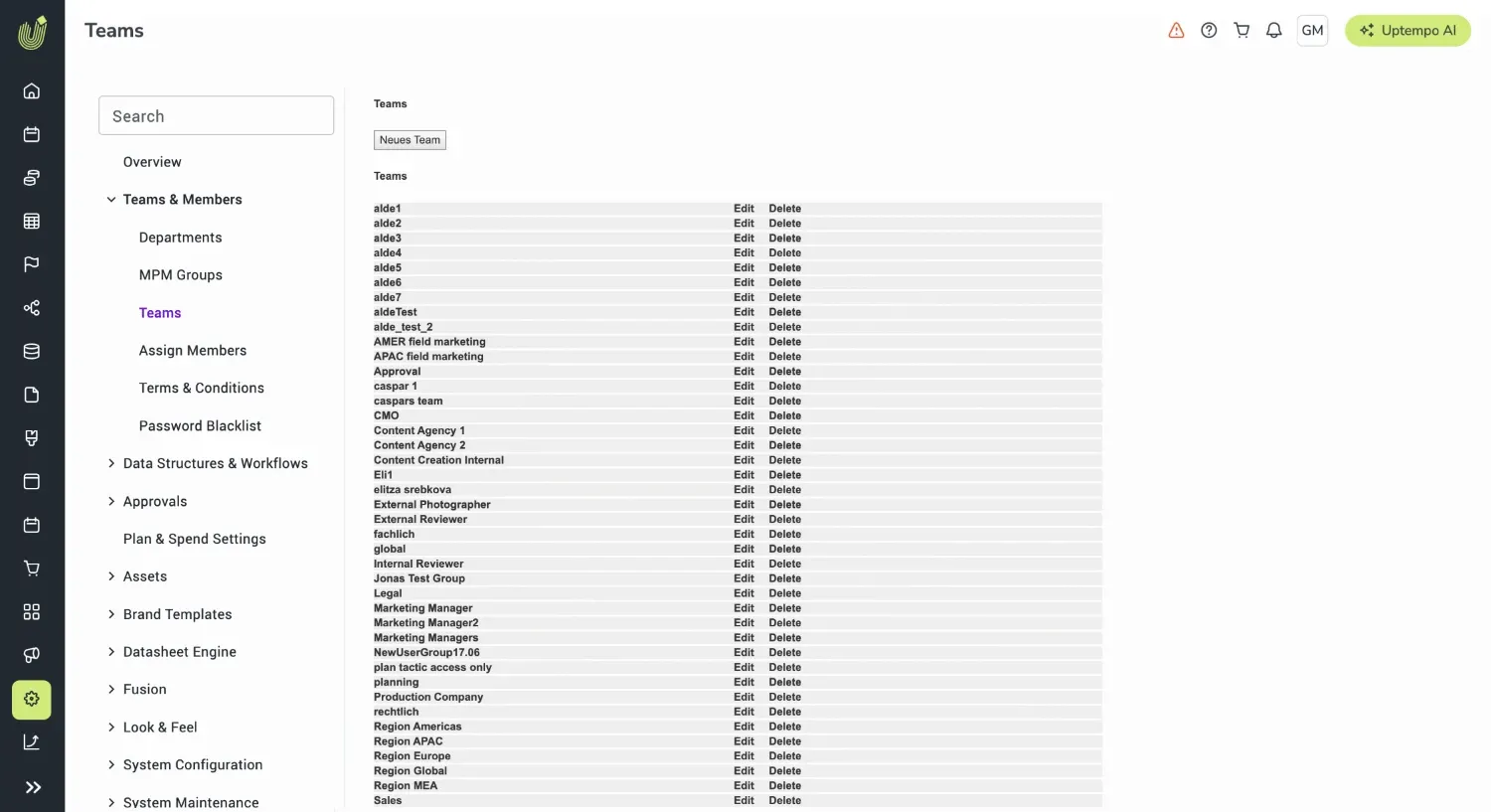
Teams Management
The Problem — Restoring cross-platform team management was stalled for over a year behind a heavy engineering backlog.
The Solution — I worked closely with my Financial Management design counterpart on an incremental rollout plan, focused strictly on minimal achievable core functionality and bridging backend infrastructure gaps with Workato integrations to meet the client's requirements for team management in the financial module.
Gallery
Capabilities Restored: Cross-platform team structures with SSO group support, delegated organizational roles, and synchronized team management across Financial Management.
5. Business Impact & Outcomes
Key insight: In enterprise B2B SaaS, design leadership isn't about pushing pixels. It's about navigating technical constraints, making pragmatic trade-offs alongside engineering, and delivering business value when client retention is on the line.
Business Impact
Objective
Solution & Execution
Impact
Enterprise account retention
Re-architected core administrative governance, permission structures, and SSO group hierarchies across the platforms
Protected key account revenue. Equipped Customer Success with tangible MVP prototypes and clear release timelines, de-escalating critical client relationships
Engineering capacity optimization
Stepped into Interim PM leadership; paused 3 non-essential initiatives and reallocated bandwidth
Established a written-first "Requirements & User Stories First" workflow ahead of Figma exploration
Eliminated wasted iterations. Delivered dev-ready PRDs and precise user stories directly to engineering
Discovery & delivery velocity
Established an AI-native discovery pipeline using Claude, Gemini, and NotebookLM, paired with a written-first PRD process
Estimated ~80% cycle-time reduction. Compressed discovery, problem framing, ideation, and hypothesis validation from weeks to days
End-to-end AI design workflow
Engineered an AI framework in Claude plus Figma MCP bridging prototyping directly to final design, reducing intermediate static canvas recreations
Estimated 50%+ velocity gain on medium-complexity initiatives, while maintaining early customer validation loops
Cross-functional alignment
Facilitated participative co-design and direct feedback loops between Product, Engineering, CS, and enterprise admins
High stakeholder trust. Replaced reactive firefighting with shared ownership and a shared source of truth
Delivery under compressed timelines
Replaced long-cycle research with "Ship First, Validate In-Market" once the validation runway was gone
Shipped inside the retention window. Core functional MVPs reached production and generated real-world feedback, converting a schedule loss into a live learning loop
Learnings & Reflections
The hardest constraint on this project was not the legacy architecture. It was time that had already been spent before the work reached me.
Indecision is expensive in a way that rarely shows up in a retrospective. No one records a week of unresolved direction as a cost, but it is subtracted from the same budget that would otherwise have paid for research, validation, and iteration. By the time we had clarity, the money was gone — and the responsible move was not to insist on a process we could no longer afford, but to find a different way to buy confidence and be transparent about the risk we were accepting.
That is also what changed my view of what design leadership is for in enterprise B2B. Craft matters, but the leverage sits earlier: in framing the problem so decisions can actually be made, in giving stakeholders something concrete to react to instead of asking them to agree in the abstract, and in holding a cross-functional group together when the schedule stops being generous.
“The clients who stayed did not stay because our screens were beautiful. They stayed because capability came back, predictably, when they needed it.”